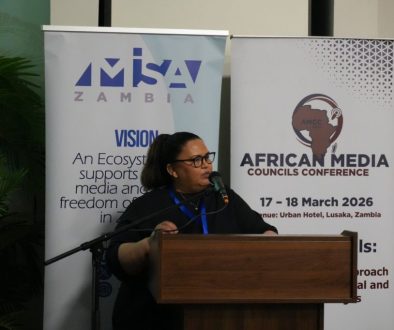

Dube’s election to new body strengthens journalism
 Zimbabwean journalist Loughty Dube has been elected as the inaugural Chairperson of the Southern African Press Councils Association (SAPC).
His election, announced in Lusaka on 19 March 2026, signals a significant shift toward stronger regional cooperation in promoting ethical journalism, accountability and press freedom.
The formation of SAPC and Dube’s rise to its leadership come at a time when the media sector across the region is navigating mounting challenges, including misinformation, declining public trust and evolving regulatory pressures.
The election took place during SAPC’s inaugural meeting, which brought together press councils and media self-regulatory bodies from across southern Africa.
The new institution represented a collective commitment to strengthening the integrity and independence of journalism in the region
Dube will be supported by a seasoned leadership team, including Phathiswa Magopeni, Executive Director of the Press Council of South Africa, and Mbongeni Mbingo of Eswatini, who will serve as Deputy Chairpersons.
Together, they are tasked with building the structures and operational frameworks of SAPC, a body expected to play a central role in shaping the future of media self-regulation in southern Africa.
The establishment of SAPC follows the adoption of the Lusaka Declaration, a guiding framework that outlines the organisation’s vision and mandate.
Founding members include the Press Council of South Africa, the Voluntary Media Council of Zimbabwe (VMCZ), the Media Ombudsman of Namibia, the Zambia Media Self-Regulation Council, the Media Council of Malawi, and representatives from Botswana and Eswatini.
At its core, SAPC seeks to promote ethical journalism, strengthen independent self-regulation systems, and facilitate knowledge sharing among member institutions. It also aims to serve as a regional voice in advancing press freedom and professional standards
Dube’s election places Zimbabwe at the forefront of this regional initiative, reflecting broader shifts within the country’s media sector. His leadership aligns with ongoing efforts to promote co-regulation, a model that balances self-regulation with statutory oversight.
Zimbabwe’s media reforms have gained momentum under the administration of Emmerson Dambudzo Mnangagwa, who has expressed support for frameworks that empower the media to regulate itself while maintaining accountability.
Speaking after his election, Dube emphasised that SAPC’s mission resonates with this national vision. He noted that strengthening ethical journalism and self-regulation is essential not only for Zimbabwe but for the region as a whole.
The timing of SAPC’s formation is particularly significant. Across southern Africa and globally, the media industry is undergoing a profound transformation. Digital platforms have accelerated the spread of misinformation, while economic pressures have strained traditional journalism models.
In this context, the need for robust, independent self-regulation has never been greater. SAPC is expected to provide a platform for collaboration, enabling member organisations to share best practices, address common challenges, and develop coordinated responses
The association will also engage with regional and continental bodies such as the Southern African Development Community and the African Union, as well as civil society and international partners, to advance media development initiatives.
The VMCZ has welcomed Dube’s election, describing it as a milestone for both the organisation and the country’s media sector. In a statement, the Council highlighted his extensive experience and unwavering commitment to ethical journalism as key factors behind his selection.
The council expressed confidence that under Dube’s stewardship, SAPC will strengthen collaboration among member institutions, enhance professional standards, and tackle pressing issues such as misinformation and threats to media freedom.
As SAPC begins its work, expectations are high. The organisation must not only establish its structures but also deliver tangible impact in a complex and rapidly evolving media environment.
Dube has a task to shape a regional framework that upholds the values of transparency, accountability and responsible journalism
In a time when trust in media is under strain, the success of SAPC could play an important role in restoring confidence and reinforcing the role of journalism as a pillar of democracy in southern Africa.
With Zimbabwe now at the helm, the region will be watching closely as this new body takes its first steps toward redefining media self-regulation.
This story was first published here
Picture, courtesy Newsday