African media leaders’ urgency for collective action
Media leaders from across Africa convened in Lusaka, Zambia, for the African Media Councils Conference 2026, a landmark gathering aimed at strengthening media self-regulation, promoting accountability and addressing emerging challenges in the digital information ecosystem.
Hosted by the Media Self-Regulation Council of Zambia (MSCZ), the conference brought together representatives from media councils, journalists, civil society and international partners under the theme, ‘Media Councils: A Solidarity-Based Approach to Regulatory, Financial and Digital Challenges’.
Opening the conference, MSCZ Chairperson Kennedy Mambwe underscored the urgency of collective action across the continent.
‘Media councils across Africa are facing growing pressure from regulatory environments, financial instability and digital transformation. This conference is about confronting that reality together.’
He emphasised that collaboration among African media councils is no longer optional but essential for survival and growth.
Participants echoed this sentiment, highlighting that many institutions operate in isolation despite facing similar challenges, including misinformation, political pressure and sustainability concerns.
Delivering the keynote address, Zambia’s Minister of Foreign Affairs and International Cooperation Mulambo Haimbe reaffirmed the government’s commitment to media freedom and ethical journalism.
‘Freedom of the press is best protected not by government intervention, but by a media that holds itself to the highest professional standards.’
He further called on media stakeholders to adapt to technological changes, including Artificial Intelligence and digital platforms, while maintaining credibility and public trust.
Kennedy Mambwe, Chairperson of the Media
Self-Regulation Council of Zambia and
Assembly President of NIMCA
Throughout the two-day conference, participants engaged in high-level discussions, plenary sessions and group work focusing on
- strengthening media accountability systems
- addressing misinformation and disinformation
- adapting to AI and digital journalism
- promoting sustainability and independence of media councils, and
- enhancing collaboration across borders
A session on accountability highlighted gaps between principles and practice in many African media systems. This remains a major challenge, shaped by political pressure, limited resources and evolving digital realities.
Participants also noted that public awareness of complaints mechanisms remains low, affecting trust and engagement
The conference provided a platform for peer learning, where media councils shared practical experiences and innovative approaches.
The Media Council of Tanzania (MCT) Executive Secretary, Ernest Sungura, contributed insights on strengthening complaints-handling mechanisms, saying, ‘building trust in the media requires systems that are accessible, transparent, and responsive to the public’.
His presentation sparked discussion on sustainability, with participants agreeing that financial independence is key to maintaining credible self-regulatory systems.
A major outcome of the conference was renewed commitment to strengthening regional cooperation, including support for the establishment of the Southern Africa Press Councils Association (SAPC) as a platform for collaboration and knowledge exchange.
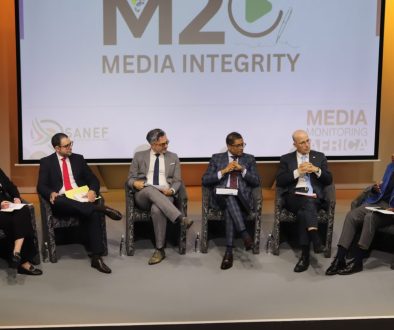
Participants at the conference in Lusaka
Participants emphasised that solidarity among African media councils is essential to address cross-border challenges and build resilient media systems. The conference reinforced the role of the Network of Independent Media Councils in Africa (NIMCA) as a central platform for coordination, peer learning and advocacy.
The conference culminated in the adoption of the Lusaka Declaration on Media Self-Regulation, Accountability, Sustainability and Information Integrity in Africa. The Declaration reaffirmed that media self-regulation remains the most effective and democratic model for ensuring accountability while safeguarding editorial independence.
It also outlined key commitments, including
- strengthening institutional independence
- promoting information integrity
- responding to artificial intelligence
- building sustainable funding models, and
- enhancing continental cooperation
As the conference concluded, participants expressed optimism about the future of media self-regulation in Africa.
This gathering has shown that African media councils are ready to work together, share solutions, and build a stronger, more credible media ecosystem
The Lusaka conference marks a significant step forward in shaping a unified, African-led approach to media accountability in an increasingly complex digital landscape.
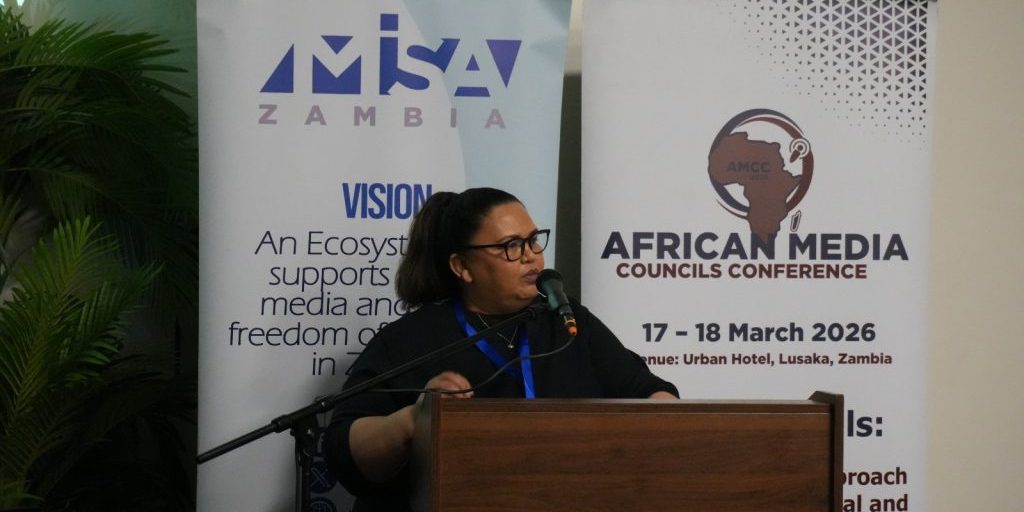
PICTURE: Zoé Titus, Director of the Namibia Media Trust, addresses the conference